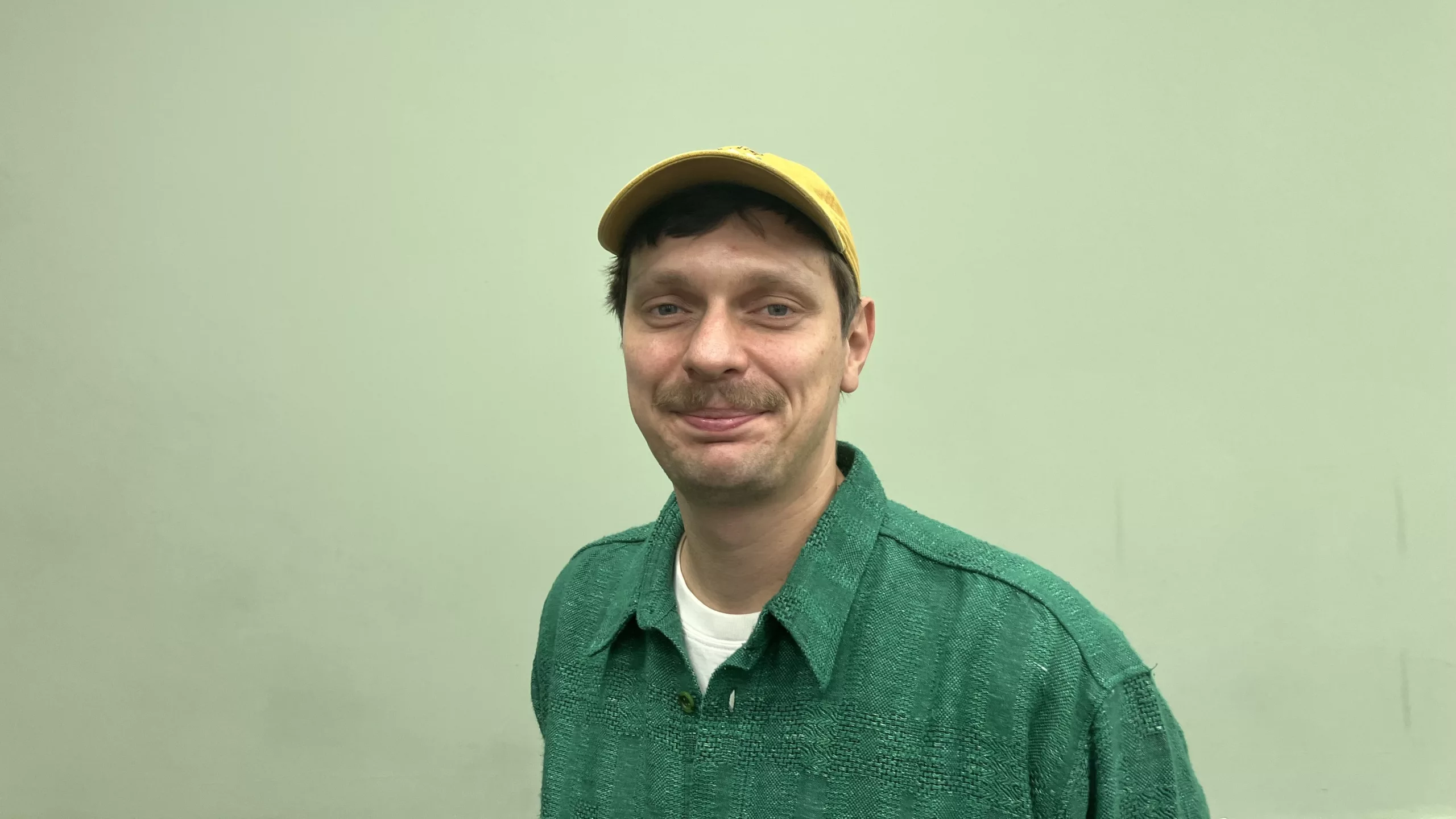
Tradition combined with experimentation – this is, in short, how one can describe the long-standing work of Miroslav Wanek and the Czech band Už jsme doma (UJD, meaning “we are home already”), a cult group also in Poland. Throughout their forty-year career, they have participated in many international projects and have had a hand in almost every area of culture.
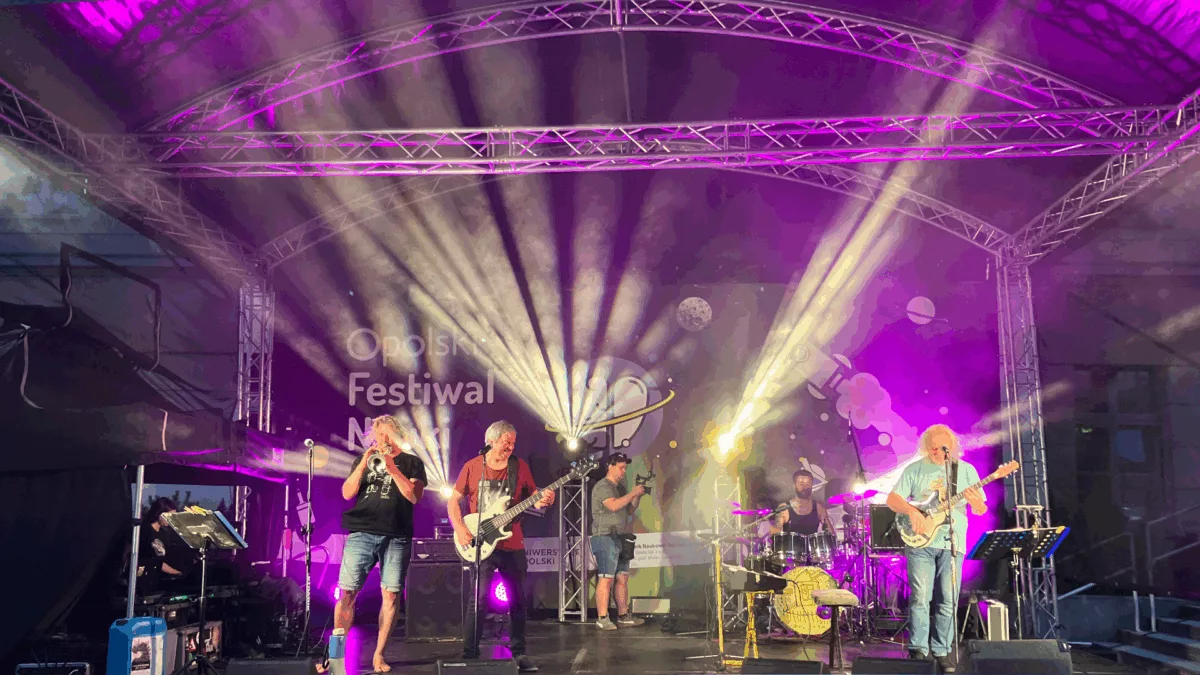
Before joining his most recognisable project, the musician played bass and sang in the punk group FPB (Fourth Price Band), which has been revived twice and currently operates sporadically. He founded it together with his neighbour Petr Růžička, the band’s future manager. One of its first members was the drummer Milan Nový, later a co-founder of UJD. It was precisely this collaboration with UJD, where Miroslav became the lead vocalist, guitarist, bassist, and keyboardist of the experimental group, that marked the beginning of a true artistic breakthrough, and our guest has remained the only member of the old line-up since joining in 1986. Miroslav has formal musical education, including two years of piano studies. His lyrics have been recognised as classics of local poetry. He is also a lecturer known for teaching the dramaturgy of music in animated films at the Film and Television Faculty of the Academy of Performing Arts in Prague. On 31 May this year, the musician appeared at the Opole Science Picnic, where we took the opportunity to talk with him and touch on several topics that, we believe, will interest you.
Benjamin Golletz: Could you introduce yourself and the band to our readers?
Miroslav Wanek: I am Mirek, and the band is called Už jsme doma. This year we are celebrating our fortieth anniversary. We started in 1985 in a town called Teplice, which lies close to the German border, about fifty kilometres from Dresden.
The band has a very long history. Have there been any musical or artistic changes over the years?
Until 1989 – during the first four or five years – I had to work a regular job. I could not make a living from music because our band was banned. But when the borders opened after the revolution, we immediately left our jobs and devoted ourselves fully to music. Since then, it has been my only occupation. We play around one hundred concerts a year practically all over the world. We have performed in forty-six countries, most often in Europe – recently, for example, in France and in Poland. Among the key overseas destinations are the United States. We played around one hundred and twenty, perhaps one hundred and thirty concerts there.
You are now performing at the Opole Science Picnic. What do you think about travelling and playing outside the country?
As I mentioned, we have already played in forty-six countries, so yes – we travel a great deal and often very far. To be honest, I no longer even consider Poland as “abroad”. After all, it is a neighbouring country. Interestingly, we have never played in Opole before. I may be mistaken, but I do not think so. We have visited dozens of other Polish cities: most often Wrocław, Kraków, Bydgoszcz, Poznań, Gdańsk, Gdynia, Katowice, Piła – we played there frequently… but never here, so I am glad that such an opportunity arose.
I was still in Japan when I received a call from the Czech Republic asking whether we would like to perform here. I replied: “Of course, we will try to organise it.” We only had to work out the logistics. Opole is close to the border, so the trip is not a problem. Playing one concert and returning within the same day, as we did today, is financially feasible. It is doable when the destination is close. However, when we go to Gdańsk, we need at least seven to fifteen concerts for such a tour to make sense. In America, we usually play between thirty and forty concerts during one tour; fewer is simply not an option. We have just returned from a tour in Japan, where we played twenty concerts.
You have many projects to your name. If someone new wanted to get to know Už jsme doma, where would you recommend they begin?
I think that many people in Poland know the film Guzikowcy (Buttoners) directed by Zelenka. We appear in that film as ourselves – the band – and the two main characters come to our concert. There was also the puppet television series Hubert i Hipolit (Hubert and Hippolyt), for which I composed all the music and in which UJD also appears. One can discover us there. Apart from that, we often play in Poland and cooperate with a Polish label from Zakopane, Nikt Nic Nie Wie, which has been releasing our longplays for many years. We feel a truly strong connection with Poland.
What originally inspired you to create music and art?
This is somewhat difficult to explain. I began at a time when – just as here in Poland – communism prevailed. Many things were forbidden, and every concert involved risk and could end with imprisonment. But when I started, I did not know this. I simply encountered this music thanks to places such as the Polish Cultural Center or the American embassy, which brought banned material into Czechoslovakia. Thanks to this, recordings of the bands I liked somehow reached me. At that time, when I was fifteen, in 1977, punk was beginning in England: Sex Pistols, The Damned. It was fresh. All of this reached us usually not even on records but on tapes, copied many times, so the quality was never very good. The recordings sounded exactly like this: noises of humming and buzzing. That was simply how it was.
Despite this, I liked the music very much and wanted to play it myself. I did not know that it was forbidden or dangerous — I was not from Prague; I am from a small town on the outskirts of the country. My dreams therefore turned into shared beginnings with friends. We carefully absorbed records, reproducing the songs we heard, and then composing our own, and that was how it all developed. I would never have suspected that this would become my occupation. I was simply a fifteen-year-old boy who wanted to play, so he played. Then I was eighteen or nineteen, and communism continued, so I was still forbidden from doing it. Over time, I met other underground musicians, such as The Plastic People of the Universe. We went to concerts and eventually performed at some together. Suddenly I realised – “Oh, I belong to the underground!”. It was a gradual path. After the revolution, it immediately became clear: this is what I want to do in life. We left our jobs and became full-time musicians.
What is the current situation of your band?
This year is our fortieth anniversary, so it is one great celebration. All our activities are related to it. We began with a tour in Japan, and extended it slightly to include Singapore and Taiwan. Now we are playing in Opole, which fits perfectly into the jubilee; it is a happy coincidence. We may return to Poland in October. The main celebration will take place on 29 July in Prague with the participation of two American bands: Sleepytime Gorilla Museum and Faun Fables. Then, at the end of August, we will perform at a festival in Mikulov – again with many guest musicians from around the world. In September, we are planning a European tour: probably France, Spain, Switzerland, the Netherlands, Germany, perhaps Poland again, as well as Denmark and Sweden. Such tours usually include thirty to forty concerts. We will conclude with a small jubilee performance in Teplice, where everything began, so it will be a fitting finale. We are also preparing a Best Of album, which I will begin to work on as soon as I return. Looking ahead, we want to release a new record next year and travel for the first time to South America – we have not yet had the opportunity. I am trying not to make plans that are too far-reaching. Short-term ones are enough.
Do you have any favourite memory from your career – funny, serious, or completely unexpected?
The most significant concert in our history took place in January 1996 in Bosnia, during the war. We travelled with the IFOR military forces, in tanks, to a small town called Goražde. It was the first time in a long while that people from outside were able to enter. We played two concerts, five hundred people each. Electricity was drawn from the hospital.
What moved me most was the reaction of the people. It did not matter whether they were fifteen, twenty, or seventy years old – they came out and called to us by name from the windows as we walked down the street. Our presence meant to the town that normal life was returning. If a band can play here, then perhaps the war is truly coming to an end. We became a symbol of freedom and peace. At that moment, I understood something we all believe in – I experienced that culture matters as much as food or medicine. For a year, tanks had been bringing them basic necessities. We brought something equally important, perhaps even more important at that moment. It created general joy. Suddenly, culture and music could speak to those people regardless of the language barrier or anything else. No one cared about any specific music genre. Suddenly, we became a symbol of the return of freedom. That was when my assumptions about the human need for art were confirmed. It made the strongest impression on me. We travelled to many places – we have been to Spitsbergen, many times to America, to Australia, to New Zealand. We played everywhere; we have probably visited almost the entire world, but Goražde will remain, for me, the greatest achievement of everything we have ever done.
What inspires you most at this moment?
As for me, and for inspiration, I no longer seek it in others. I created my musical style forty years ago and I continue to work within it. No one else plays what we play. It is something very specific. Current music does not influence me. I still have many ideas in relation to my musical style. But on the other hand, of course, from time to time I listen to something; perhaps I will like something – some things more, others less. I have never been a great listener; I have always been most absorbed in my own work. In my free time, I read literature. We play a great deal, so, as today, we meet other bands on stage. Naturally, I listen to them. Sometimes they put a CD into my hand so that I can listen to it at home. Nevertheless, I do not consider myself a good adviser on what is worth listening to.
Once in Piła we met a man who ran a private radio station and was a great collector, with a vinyl collection no smaller than five thousand. We asked him what genre he would classify UJD as. He thought for a moment and said: “Už jsme doma? That is precisely the genre. That is the name of the style.” And I agree with that; it is the truth.
When I was starting, punk inspired me – bands such as Sex Pistols, and later the American avant-garde group The Residents, which for me is also one of the most important bands. Later, we met, became friends, and even recorded an album together. So one could say that I have fulfilled most of my musical dreams.
Lastly: do you have any message for our readers?
I encourage them to listen to us. If they enjoy our music, they may discover much more through it. There is an entire avant-garde scene called Rock in Opposition. There is a global avant-garde scene, and if someone comes to like avant-garde music through us, they may discover dozens of other incredible bands and music about which they probably know nothing at this moment. Because it is not mainstream music that would appear on television or anywhere else, perhaps not even on Spotify. The avant-garde scene is quite specific. Through Už jsme doma one can enter this world, see whom we play with, and discover other valuable bands. Poland also has a strong avant-garde tradition, which once inspired us as well. When I was thirteen, the band SBB and Józef Skrzek were important for me. I even have a photograph. When they played in Teplice at that time, I went to Skrzek for an autograph while he was looking down the corridor, standing there and explaining something. I stood there with a little notebook, waiting for my turn. That moment had a great influence on me; it was a huge inspiration. I began with progressive rock before I became interested in pop, commercial music, and punk. I do not claim that we have much in common, but I am sure that part of those roots can still be heard somewhere in our music.
Thank you very much for the conversation and for your time.
The pleasure is entirely mine.
In a single article it would not be possible to address all the topics related to Miroslav Wanek and his band, so we would like to invite you to explore their history and work on your own. The internet, especially the Czech internet (often quite understandable for us), is full of their recordings, texts on their history, announcements of future endeavours, and reports from events.
The performance preceding this interview aimed to promote the degree programme in Anthropological and Cultural Bohemian Studies at the Faculty of Philology of the University of Opole. The event attracted many fans of the group, who were delighted by the long-awaited arrival of the artists in the capital of Polish song.
We sincerely thank the Institute of Literary Studies of the University of Opole and its director, Dr. Hab. Paweł Marcinkiewicz, Professor of UO, and Dr. Hab. Aleksandra Pająk-Głogiewicz, Professor of UO, for their invaluable help in organising the interview and making it possible. Additionally, we thank Emilia Noczyńska and Gabriela Gordoń for additional help with correcting the finalized Polish text.
(photo: OPOlink.pl)


You might be interested in...